
—-Scroll down to read the German and French version—-
Overcoming neo-colonial dependency: Fair prices for gold can strengthen Burkina Faso
At a glance: Burkina Faso is one of Africa’s largest gold producers, yet international companies control large parts of gold production, whilst profits and further processing are predominantly channelled abroad. Fair prices, greater state involvement, local processing and transparent supply chains could help Burkina Faso gain greater economic sovereignty and ensure that its gold wealth is invested more heavily in local education, healthcare, infrastructure and sustainable development.
I came across this topic rather by chance: I was attending a webinar on AI-powered trading. The session promised high profits – from trading in gold. Immediately, the long history of raw material exploitation in Burkina Faso came to mind, along with the question:
How is it possible that profits are being made from gold, both virtually and physically, across the globe, whilst the people in the countries where this gold comes from hardly benefit from it at all?
According to the World Gold Council, Burkina Faso was Africa’s third-largest gold producer in 2024, with 94.4 tonnes. Yet despite this wealth, neither the government nor the local people benefit adequately. Historical power structures and current trading practices mean that a large proportion of value creation takes place outside the country. This imbalance is an expression of neo-colonial dependency, in which raw materials are exported whilst profits and control remain in the Global North – and this after more than 65 years of independence. Fair prices and more equitable participation models could make a decisive difference here.
Neocolonial structures in the gold sector
This problem is particularly evident in the gold sector. International mining companies such as the Canadian firms Iamgold and Semafo, which later merged with the London-listed company Endeavour Mining, as well as the Russian firm Nordgold and the Australian company West African Resources (WAF), control a large proportion of industrial gold production.
As the infographic shows, WAF holds around 85% of the shares in major gold projects, whilst the Burkinabe state holds a mere 15%. Although this stake was increased by a new mining law, the balance of power remains significantly skewed. For the local population, this means that the resources come from their land, yet the lion’s share of the profits flows abroad. At the same time, communities often bear the social and environmental consequences of mining.
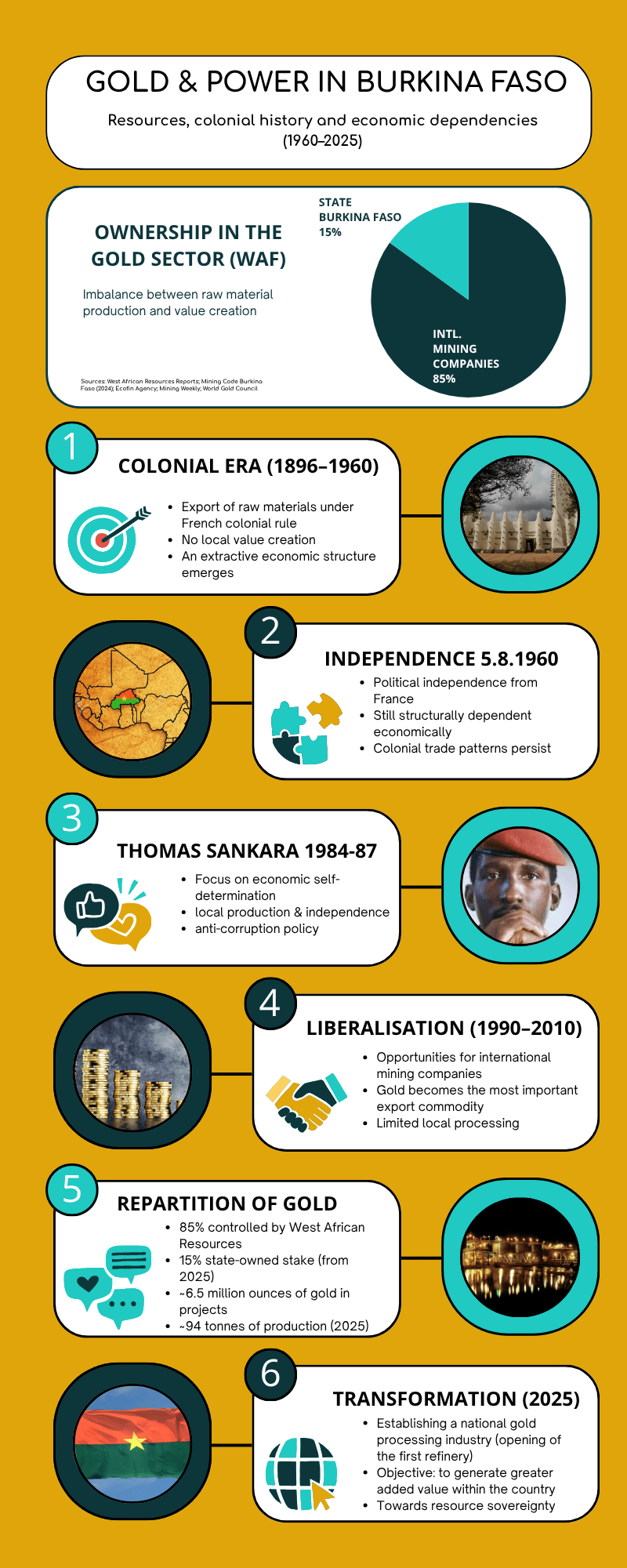
Film example: ‘No Gold for Kalsaka’
The documentary film ‘No Gold for Kalsaka’ by Michel K. Zongo provides a striking example of these dynamics. It depicts a village where traditional gold mining has been a vital means of livelihood for years. With the arrival of a multinational mining company, the situation changes fundamentally: industrial mining displaces local structures, exacerbates environmental problems such as water scarcity, and deprives many people of their economic livelihood. Although the gold continues to come from the region, the actual value creation increasingly takes place outside the country. The film thus brings to light what often remains invisible in macroeconomic statistics: the gap between global resource exploitation and local realities of life.
Why the local population benefits so little
The reasons for this are structural and interlinked:
- Ownership and control lie abroad
International companies own the majority of shares in the mines. Profits therefore flow predominantly to external investors.
- Value creation does not take place locally
Gold is mostly exported unprocessed. Further processing – and thus the greatest economic profit – takes place abroad.
- Global pricing structures disadvantage producers
Prices are set on international markets, not locally. Producers have little influence over their own income.
- Financial markets are becoming detached from reality
A large proportion of the profits in the gold trade today comes from financial products and trading, not from the physical commodity itself. This means that even if the gold comes from Burkina Faso, those who mine it do not benefit from the global trading profits.
Why fair prices are crucial
Fair prices in the commodities trade – particularly for gold – would at least partially correct this imbalance. If producers in Burkina Faso receive a fair share of the market value, new opportunities for development arise, such as:
– Investment in education and healthcare
– Expansion of local infrastructure
– Promotion of sustainable working conditions
Fair prices are therefore not just a question of ethics, but also a key lever for long-term economic development.
More than just prices: strengthening local value creation
Alongside fair pricing, local processing plays a central role. As long as raw materials are predominantly exported, the majority of value creation remains outside the country. Greater state involvement, investment in industrial processing and transparent partnerships could help Burkina Faso gain more control over its resources. The construction of the first gold refinery in 2025 was an important step in this direction.
The Global North’s Responsibility
The Global North also bears responsibility for these structures. Companies profit from cheap raw materials, whilst consumers are often unaware of the conditions under which these are extracted. A more conscious approach to resources can start here: companies should establish transparent supply chains, investors should pay attention to ethical standards, and we as consumers can specifically support fair trade products.
Conclusion
The example of the gold sector clearly illustrates how neo-colonial dependency works today: raw materials are extracted locally, whilst profits and control are distributed globally – mostly to the benefit of external actors.
Fair prices, fairer profit-sharing and greater local value creation are key building blocks for overcoming these structures. Burkina Faso has the potential to transform its wealth of raw materials into sustainable development – provided the global rules of the game change.
About the author:
 Tanja Diallo is the founder of Diallo tissue tales – with over 30 years experience in editorial work and fashion design. The blog “Stoffgeschichten” (Tissue Tales) by the brand Diallo tissue tales focuses on textile creativity, handcrafted decolonial fabrics from West Africa and regular trips to Burkina Faso, fair collaboration with women-led organisations on an equal footing, and the connection between fabric, dignity and visibility.
——————————————————————————————–
Neokoloniale Abhängigkeit überwinden: Faire Preise für Gold stärken Burkina Faso
Auf einen Blick: Burkina Faso gehört zu den größten Goldproduzenten Afrikas, doch internationale Unternehmen kontrollieren große Teile der Goldproduktion, während Gewinne und Weiterverarbeitung überwiegend ins Ausland fließen. Faire Preise, stärkere staatliche Beteiligung, lokale Verarbeitung und transparente Lieferketten könnten dazu beitragen, dass Burkina Faso mehr wirtschaftliche Souveränität gewinnt und Goldreichtum stärker in Bildung, Gesundheit, Infrastruktur und nachhaltige Entwicklung vor Ort investiert wird.
Auf dieses Thema bin ich eher zufällig gestoßen: Ich habe mich in einem Webinar zu KI-gestütztem Trading informiert. Dabei wurden hohe Gewinne in Aussicht gestellt – mit Goldhandel. Sofort kam bei mir die lange Geschichte der Rohstoffausbeutung Burkina Faso an die Oberfläche und die Frage:
Wie kann es sein, dass weltweit virtuell und physisch mit Gold Gewinne erzielt werden, während die Menschen in den Ländern, aus denen dieses Gold stammt, kaum davon profitieren?
Nach Angaben des World Gold Council war Burkina Faso 2024 mit 94,4 Tonnen im Jahr 2024 der drittgrößte Goldproduzent Afrikas. Doch trotz dieses Reichtums profitieren weder die Regierung noch die Menschen vor Ort angemessen. Historische Machtstrukturen und aktuelle Handelspraktiken führen dazu, dass ein Großteil der Wertschöpfung außerhalb des Landes stattfindet. Dieses Ungleichgewicht ist Ausdruck einer neokolonialen Abhängigkeit, in der Rohstoffe exportiert werden, während Gewinne und Kontrolle im globalen Norden verbleiben – und das nach mehr als 65 Jahren Unabhängigkeit. Faire Preise und gerechtere Beteiligungsmodelle könnten hier einen entscheidenden Unterschied machen.
Neokoloniale Strukturen im Goldsektor
Besonders deutlich wird diese Problematik im Goldsektor. Internationale Bergbauunternehmen wie die kanadischen Firmen Iamgold und Semafo, die später mit dem in London notierten Unternehmen Endeavour Mining fusionierten, sowie die russische Nordgold und die australische West African Resources (WAF) kontrollieren einen Großteil der industriellen Goldproduktion.
Wie die Infografik zeigt, hält WAF etwa 85 % der Anteile an wichtigen Goldprojekten, während der burkinische Staat lediglich mit 15 % beteiligt ist. Obwohl diese Beteiligung durch ein neues Bergbaugesetz erhöht wurde, bleibt das Machtverhältnis deutlich unausgewogen. Für die lokale Bevölkerung bedeutet das: Die Ressourcen stammen aus ihrem Land, doch der größte Teil der Gewinne fließt ins Ausland. Gleichzeitig tragen Gemeinden oft die sozialen und ökologischen Folgen des Bergbaus.
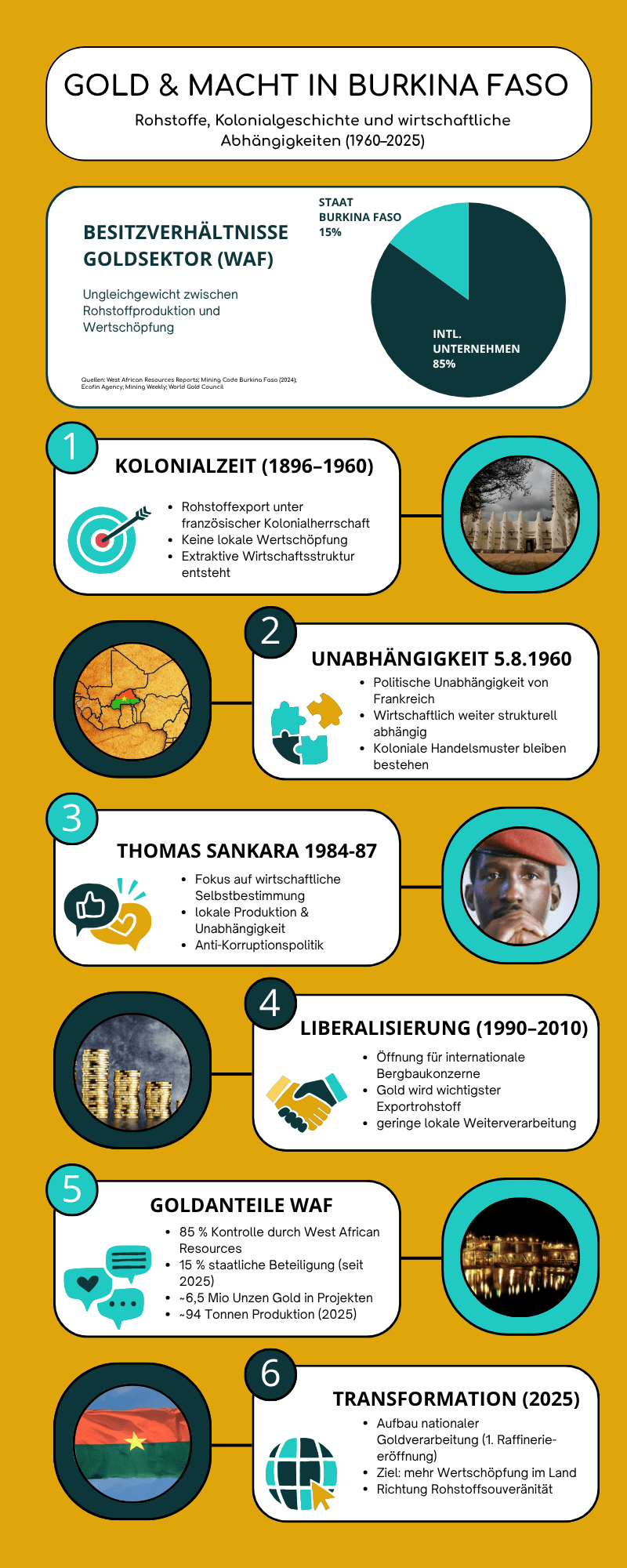
Filmisches Beispiel: „No Gold for Kalsaka“
Ein eindrückliches Beispiel für diese Dynamiken liefert der Dokumentarfilm No Gold for Kalsaka von Michel K. Zongo. Er zeigt ein Dorf, in dem traditioneller Goldabbau über Jahre hinweg eine wichtige Lebensgrundlage war. Mit dem Eintritt eines multinationalen Bergbauunternehmens verändert sich die Situation grundlegend: Industrieller Abbau verdrängt lokale Strukturen, verschärft Umweltprobleme wie Wasserknappheit und entzieht vielen Menschen ihre wirtschaftliche Basis. Obwohl das Gold weiterhin aus der Region stammt, findet die eigentliche Wertschöpfung zunehmend außerhalb des Landes statt. Der Film macht damit sichtbar, was in makroökonomischen Statistiken oft unsichtbar bleibt: die Kluft zwischen globaler Rohstoffverwertung und lokaler Lebensrealität.
Warum die Bevölkerung kaum profitiert
Die Gründe dafür sind strukturell und greifen ineinander:
- Eigentum und Kontrolle liegen im Ausland
Internationale Unternehmen besitzen die Mehrheit der Anteile an den Minen. Gewinne fließen daher überwiegend an externe Investoren. - Wertschöpfung findet nicht vor Ort statt
Gold wird meist unverarbeitet exportiert. Die Weiterverarbeitung – und damit der größte wirtschaftliche Gewinn – erfolgt im Ausland. - Globale Preisstrukturen benachteiligen Produzent:innen
Die Preise werden auf internationalen Märkten festgelegt, nicht lokal. Produzent:innen haben kaum Einfluss auf ihre eigenen Einnahmen. - Finanzmärkte entkoppeln sich von der Realität
Ein Großteil der Gewinne im Goldhandel entsteht heute durch Finanzprodukte und Trading, nicht durch den physischen Rohstoff selbst. Das bedeutet: Selbst, wenn das Gold aus Burkina Faso stammt, profitieren diejenigen, die es fördern, nicht von den globalen Handelsgewinnen.
Warum faire Preise entscheidend sind
Faire Preise im Rohstoffhandel – insbesondere bei Gold – würden dieses Ungleichgewicht zumindest teilweise korrigieren. Wenn Produzent:innen in Burkina Faso einen angemessenen Anteil am Marktwert erhalten, entstehen neue Entwicklungsspielräume, etwa für:
- Investitionen in Bildung und Gesundheitsversorgung
- Ausbau lokaler Infrastruktur
- Förderung nachhaltiger Arbeitsbedingungen
Faire Preise sind daher nicht nur eine Frage der Ethik, sondern auch ein zentraler Hebel für langfristige wirtschaftliche Entwicklung.
Mehr als Preise: Lokale Wertschöpfung stärken
Neben Preisgerechtigkeit spielt die lokale Verarbeitung eine zentrale Rolle. Solange Rohstoffe überwiegend exportiert werden, bleibt der Großteil der Wertschöpfung außerhalb des Landes. Eine stärkere staatliche Beteiligung, Investitionen in industrielle Verarbeitung und transparente Partnerschaften könnten dazu beitragen, dass Burkina Faso mehr Kontrolle über seine Ressourcen gewinnt. Der Aufbau einer ersten Goldraffinerie im Jahr 2025 war dabei ein wichtiger Schritt in Richtung wirtschaftlicher Souveränität.
Verantwortung des globalen Nordens
Auch der globale Norden trägt Verantwortung für diese Strukturen. Unternehmen profitieren von günstigen Rohstoffen, während Konsument:innen oft nicht wissen, unter welchen Bedingungen diese gewonnen werden. Ein bewussterer Umgang mit Ressourcen kann hier ansetzen: Unternehmen sollten transparente Lieferketten etablieren, Investoren auf ethische Standards achten und wir als Konsument:innen können gezielt faire Produkte unterstützen.
Fazit
Das Beispiel des Goldsektors zeigt eindrücklich, wie neokoloniale Abhängigkeit heute funktioniert: Rohstoffe werden lokal gewonnen, während Gewinne und Kontrolle global verteilt sind – meist zugunsten externer Akteure.
Faire Preise, gerechtere Beteiligungen und stärkere lokale Wertschöpfung sind zentrale Bausteine, um diese Strukturen zu überwinden. Burkina Faso hat das Potenzial, seinen Rohstoffreichtum in nachhaltige Entwicklung umzuwandeln – vorausgesetzt, die globalen Spielregeln ändern sich.
Über die Autorin
Tanja Diallo ist Gründerin von Diallo tissue tales – mit mehr als 30 Jahren Erfahrung in Redaktion und Modegestaltung. Im Blog „Stoffgeschichten“ der Marke Diallo tissue tales geht es um textile Kreativität, kunsthandwerklich gefertigte dekoloniale Stoffe aus West Afrika und regelmäßige Reisen nach Burkina Faso, faire Zusammenarbeit mit frauengeführten Organisationen auf Augenhöhe und die Verbindung von Stoff, Würde und Sichtbarkeit.
—————————————————————————–
Surmonter la dépendance néocoloniale: Des prix équitables pour l‘or renforcent le Burkina Faso
En bref : le Burkina Faso figure parmi les plus grands producteurs d’or d’Afrique, mais les entreprises internationales contrôlent une grande partie de la production aurifère, tandis que les bénéfices et la transformation sont principalement réalisés à l’étranger. Des prix équitables, une participation accrue de l’État, une transformation locale et des chaînes d’approvisionnement transparentes pourraient contribuer à renforcer la souveraineté économique du Burkina Faso et à investir davantage les richesses issues de l’or dans l’éducation, la santé, les infrastructures et le développement durable au niveau local.
Je suis tombé sur ce sujet plutôt par hasard: je m’informais lors d’un webinaire sur le trading assisté par l’IA. On y promettait des profits élevés – grâce au commerce de l’or. Immédiatement, la longue histoire de l’exploitation des matières premières au Burkina Faso m’est revenue à l’esprit, ainsi que cette question:
Comment se fait-il que l’on réalise des profits avec l’or, tant virtuellement que physiquement, à l’échelle mondiale, alors que les populations des pays d’où provient cet or n’en tirent pratiquement aucun bénéfice ?
Selon les données du World Gold Council, le Burkina Faso était en 2024 le troisième producteur d’or d’Afrique, avec 94,4 tonnes. Pourtant, malgré cette richesse, ni le gouvernement ni les populations locales n’en tirent un bénéfice adéquat. Les structures de pouvoir historiques et les pratiques commerciales actuelles font qu’une grande partie de la valeur ajoutée est générée en dehors du pays. Ce déséquilibre est l’expression d’une dépendance néocoloniale dans laquelle les matières premières sont exportées, tandis que les profits et le contrôle restent dans les pays du Nord – et ce, après plus de 65 ans d’indépendance. Des prix équitables et des modèles de participation plus justes pourraient faire une différence décisive à cet égard.
Structures néocoloniales dans le secteur aurifère
Cette problématique est particulièrement flagrante dans le secteur aurifère. Des sociétés minières internationales telles que les entreprises canadiennes Iamgold et Semafo, qui ont par la suite fusionné avec la société Endeavour Mining cotée à Londres, ainsi que la société russe Nordgold et l’australienne West African Resources (WAF), contrôlent une grande partie de la production industrielle d’or.
Comme le montre l’infographie, WAF détient environ 85 % des parts dans d’importants projets aurifères, tandis que l’État burkinabé ne détient que 15 %. Bien que cette participation ait été augmentée par une nouvelle loi minière, le rapport de force reste nettement déséquilibré. Pour la population locale, cela signifie que les ressources proviennent de leur pays, mais que la majeure partie des bénéfices part à l’étranger. Dans le même temps, ce sont souvent les communautés qui supportent les conséquences sociales et écologiques de l’exploitation minière.
Exemple cinématographique: « No Gold for Kalsaka »
Le documentaire No Gold for Kalsaka de Michel K. Zongo offre un exemple frappant de ces dynamiques. Il montre un village où l’exploitation aurifère traditionnelle a constitué pendant des années un moyen de subsistance essentiel. Avec l’arrivée d’une multinationale minière, la situation change radicalement: l’exploitation industrielle supplante les structures locales, aggrave les problèmes environnementaux tels que la pénurie d’eau et prive de nombreuses personnes de leur base économique. Bien que l’or continue de provenir de la région, la création de valeur proprement dite s’effectue de plus en plus en dehors du pays. Le film met ainsi en lumière ce qui reste souvent invisible dans les statistiques macroéconomiques: le fossé entre l’exploitation mondiale des matières premières et la réalité locale.
Pourquoi la population n’en tire-t-elle pratiquement aucun bénéfice ?
Les raisons sont structurelles et s’entrecroisent:
- La propriété et le contrôle sont détenus à l’étranger
Les entreprises internationales détiennent la majorité des parts des mines. Les bénéfices reviennent donc principalement à des investisseurs externes.
- La valeur ajoutée n’est pas créée sur place
L’or est généralement exporté à l’état brut. La transformation – et donc le plus gros bénéfice économique – a lieu à l’étranger.
- Les structures de prix mondiales désavantagent les producteurs
Les prix sont fixés sur les marchés internationaux, et non localement. Les producteurs n’ont pratiquement aucune influence sur leurs propres revenus.
- Les marchés financiers se déconnectent de la réalité
Une grande partie des bénéfices du commerce de l’or provient aujourd’hui des produits financiers et du trading, et non de la matière première physique elle-même. Cela signifie que même si l’or provient du Burkina Faso, ceux qui l’extraient ne profitent pas des bénéfices du commerce mondial.
Pourquoi des prix équitables sont essentiels
Des prix équitables dans le commerce des matières premières – en particulier pour l’or – corrigeraient au moins en partie ce déséquilibre. Si les producteurs du Burkina Faso reçoivent une part équitable de la valeur marchande, de nouvelles perspectives de développement s’ouvrent, notamment pour :
– les investissements dans l’éducation et les soins de santé
– le développement des infrastructures locales
– la promotion de conditions de travail durables
Des prix équitables ne sont donc pas seulement une question d’éthique, mais aussi un levier essentiel pour le développement économique à long terme.
Au-delà des prix: renforcer la valeur ajoutée locale
Outre l’équité des prix, la transformation locale joue un rôle central. Tant que les matières premières sont principalement exportées, la majeure partie de la valeur ajoutée reste hors du pays. Une participation accrue de l’État, des investissements dans la transformation industrielle et des partenariats transparents pourraient contribuer à ce que le Burkina Faso acquière davantage de contrôle sur ses ressources. La construction d’une première raffinerie d’or en 2025 a constitué une étape importante dans cette direction.
La responsabilité du Nord
Le Nord porte lui aussi une part de responsabilité dans ces structures. Les entreprises tirent profit de matières premières bon marché, tandis que les consommatrices et consommateurs ignorent souvent dans quelles conditions celles-ci sont extraites. Une gestion plus responsable des ressources peut être un point de départ : les entreprises devraient mettre en place des chaînes d’approvisionnement transparentes, les investisseurs veiller au respect des normes éthiques et nous, en tant que consommatrices et consommateurs, pouvons soutenir de manière ciblée les produits équitables.
Conclusion
L’exemple du secteur aurifère montre de manière frappante comment fonctionne aujourd’hui la dépendance néocoloniale: les matières premières sont extraites localement, tandis que les profits et le contrôle sont répartis à l’échelle mondiale – le plus souvent au profit d’acteurs externes.
Des prix équitables, une répartition plus juste des bénéfices et une plus forte création de valeur locale sont des éléments essentiels pour surmonter ces structures. Le Burkina Faso a le potentiel de transformer sa richesse en matières premières en développement durable – à condition que les règles du jeu mondiales changent.
À propos de l’auteure
Tanja Diallo est la fondatrice de Diallo tissue tales – forte de plus de 30 ans d’expérience dans la rédaction et la création de mode. Le blog « Stoffgeschichten » (Histoires de tissus) de la marque Diallo tissue tales traite de la créativité textile, des tissus décoloniaux fabriqués artisanalement en Afrique de l’Ouest et des voyages réguliers au Burkina Faso, de la collaboration équitable avec des organisations dirigées par des femmes sur un pied d’égalité, ainsi que du lien entre tissu, dignité et visibilité.
 French
  German